- House 61(1st Floor), Block F, Road 08, Banani, Dhaka-1213
- info@sunrise-bd.net

Italy Public University Tuition Fees 2026: Complete Cost Guide for Bangladeshi Students

Planning to
Study
in Abroad
- World Class Institution
- Quality Education
- Affordable Fees
* Terms & Conditions
Make an Appointment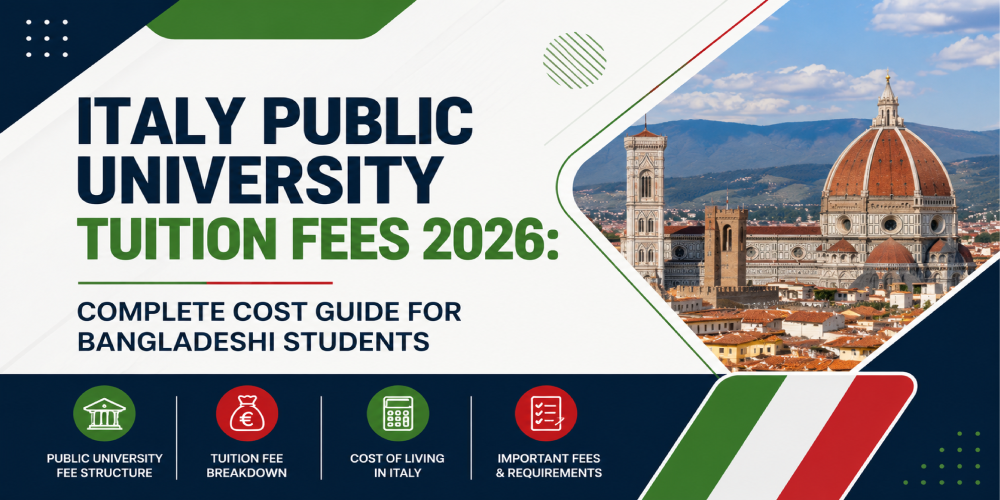
Italy Public University Tuition Fees 2026: Complete Cost Guide for Bangladeshi Students
If you've searched "Italy public university tuition fee" and landed on a page telling you it's simply "€500 to €4,000 a year," you've got half the picture. Italian public university tuition isn't a flat number: it's calculated individually, based on an income-assessment figure called the ISEE (or its international-student equivalent, the ISEE Parificato), and getting this wrong, or missing the submission deadline, can lock you into paying up to ten times more than a properly filed application would cost. At Sunrise Education Consultants, we've walked Bangladeshi students through this exact process, so this guide breaks down not just the fee ranges you'll find everywhere else, but how the system actually works, university by university, with real 2026 figures pulled directly from official university sources.
Quick answer: Public university tuition in Italy for the 2026/27 academic year typically ranges from as low as €156/year (lowest ISEE income bracket) to around €3,900/year (maximum bracket, for students who don't submit income documentation), depending on the university and your family's assessed financial situation. Private universities charge considerably more, roughly €3,800 to €25,000+ per year. On top of tuition, budget for a small fixed administrative fee (roughly €140-160) and a regional tax that also scales with income.
How Italy's Tuition System Actually Works
Here's the part almost every guide skips: Italian public universities don't set one tuition price per program. Instead, they calculate what you pay individually, using a formula tied to your family's financial standing. The tool that determines this is called the ISEE, short for Indicatore della Situazione Economica Equivalente, or "Equivalent Economic Situation Indicator." It's an Italian government mechanism originally designed for Italian citizens, but international students, including Bangladeshi applicants, can access an equivalent version called the ISEE Parificato, sometimes labeled "Equivalent ISEE" or "ISEEU" (the university-specific variant) on admissions portals.
In practice, this means two students admitted to the same program at the same university can pay wildly different tuition: one might pay €200 for the year, another might pay €3,800, purely based on documented family income. This is genuinely good news for most Bangladeshi families, since Bangladesh's average household income, once converted and assessed under Italian brackets, tends to place applicants in the lower-to-middle tiers rather than the maximum bracket.
Public University Tuition Fees by Institution (2026)
Rather than giving you one blended average like most guides do, here's what specific, well-known Italian public universities are actually charging, pulled from each university's official fee page:
A pattern worth noticing: Politecnico di Milano and Sapienza can be cheaper for a low-ISEE-bracket international student than several "budget" private colleges elsewhere, which is exactly why understanding your bracket matters more than just picking a university based on its reputation for being "affordable."
ISEE Income Brackets Explained
Universities publish their brackets slightly differently, but Politecnico di Milano's 2026/27 structure is a useful, transparent example of how the tiering actually works:
ISEE up to €26,887.93: regional tax of €130 (lowest tier, and the threshold that also determines scholarship eligibility)
ISEE from €26,887.94 to €53,775.88: regional tax of €160
ISEE above €53,775.89, or no ISEE submitted: regional tax of €190 (maximum, applied by default if you skip the paperwork)
This regional tax is a small piece of your total bill; the larger, main tuition component (called the Contributo Onnicomprensivo at most universities) scales the same way, which is how the total swings from roughly €130 at the bottom to nearly €3,900 at the top. Some universities offering the lowest ISEE tier bring total annual tuition as low as €156-600/year for students who clearly qualify as lower-income under the Italian assessment, genuinely close to free, tuition-wise, once you account for the mandatory minimum fixed fee every student pays regardless of bracket.
Private University Tuition Fees
Private Italian universities don't use the ISEE system; they set flat tuition, generally higher than even the maximum public-university bracket:
Private universities can still make sense for specific programs; fashion, design, and certain MBA-style business programs are areas where Italy's private institutions have a stronger international reputation than the public alternative, but for most academic fields, a well-documented ISEE Parificato application to a public university will cost dramatically less for the same or better academic outcome.
Beyond Tuition: The Mandatory Fees Nobody Mentions
Every guide quotes "tuition," but almost none mention the small, mandatory add-ons that apply regardless of your ISEE bracket. Budget for these on top of whatever tuition figure applies to you:
Regional tax for right-to-study (tassa regionale): €130-190/year, tiered by ISEE, as shown above.
Fixed administrative fee (imposta di bollo / tassa fissa): roughly €140-160/year at most universities (Bologna's is €157.04 specifically).
Stamp duty (marca da bollo): a small one-time charge, typically around €16.
Late-filing penalty: if you miss your ISEE Parificato deadline (usually in October), expect a separate penalty fee on top of being bumped to the maximum tuition bracket; one university's documented penalty for this alone is €200.
None of these individually are large, but together they can add €300-400/year on top of your headline tuition figure, worth building into your budget from day one rather than discovering them mid-year.
Tuition + Living Costs Combined (EUR & BDT)
Tuition is only one part of your annual cost. Combined with realistic living expenses, here's what a full year looks like at different ISEE brackets, converted at approximately 1 EUR ≈ ৳143 (August 2026 rate):
For a full country-by-country comparison of what this looks like against the USA, UK, Canada, and Australia, see our Cost of Studying Abroad from Bangladesh guide. Italy remains the most affordable major destination on that list, and this tuition breakdown is exactly why.
How to Qualify for the Lowest ISEE Bracket
Gather your family's financial documentation early: income statements, property records, and bank statements, translated and prepared for the ISEE Parificato assessment.
Submit through your target university's designated portal (each university runs its own ISEE Parificato submission process; check the specific international office instructions, since procedures differ between Sapienza, Bologna, Politecnico di Milano, and others).
Don't miss the deadline: this is typically in October for the current academic year, and it is not flexible. Universities have explicitly stated that visa or embassy delays are not accepted as grounds for an extension.
Also check DSU regional scholarships (Diritto allo Studio Universitario): separate from the ISEE tuition reduction, these regional right-to-study grants can cover tuition entirely and sometimes include a living stipend, based on merit and financial need. We cover eligibility and application timing for these across all your study destinations in our Scholarship Arrangement service.
Common Mistake: Missing the ISEE Deadline
This is worth its own section because of how costly it is. If your ISEE Parificato documentation isn't submitted correctly by the university's deadline, even by a few days, even because of a documented embassy or visa delay, you get placed in the maximum tuition bracket automatically, with no retroactive appeal at most institutions. At Politecnico di Milano, for example, this means paying the full €3,898 rather than whatever your actual income bracket would have qualified you for, potentially the €130–160 tier. Given the gap between brackets can be 10-20x, this single administrative step is arguably more consequential to your total cost than which public university you choose.
Application & Visa: What Comes Next
Once you've selected a university and understand which tuition bracket you're likely to fall into, the next steps are university pre-enrollment through the Universitaly portal, followed by your Type D student visa application. We cover the complete process, including the current 2026/27 block visa financial requirement, in our full study in Italy from Bangladesh guide. For hands-on visa filing support, our Counselling and VISA Processing team handles this end-to-end, and our University Admission Process service can help you select the right program and prepare a strong ISEE Parificato application from the start.
Frequently Asked Questions
How much is public university tuition in Italy for Bangladeshi students?
It depends on your ISEE Parificato income assessment: as low as €156-600/year for the lowest income bracket, up to roughly €3,000-3,900/year for the maximum bracket. Most Bangladeshi families, once assessed under Italian income brackets, fall into the lower-to-middle tiers rather than the maximum.
What is ISEE Parificato and why does it matter?
It's the international-student equivalent of Italy's ISEE income-assessment system, used to calculate your individual tuition rate at public universities. Submitting it correctly and on time can reduce your tuition by up to 90% compared to the maximum bracket; missing the deadline locks you into paying the maximum rate with no exceptions at most universities.
Is Italian public university tuition really cheaper than private university tuition?
Yes, substantially, for most students. Public universities range from €156 to about €3,900/year depending on your ISEE bracket, while private universities charge flat rates from €3,800 up to €25,000+/year regardless of family income.
Do all Italian public universities use the same tuition brackets?
No, each university sets its own specific bracket thresholds and fixed fees, though the underlying ISEE Parificato mechanism is the same nationally. Politecnico di Milano, Sapienza, and the University of Bologna each publish their own fee schedules, which is why we've listed them separately above rather than giving one blended average.
What other fees should I budget for beyond tuition?
Every student, regardless of ISEE bracket, pays a small fixed administrative fee (roughly €140–160/year) and a one-time stamp duty (around €16). These are separate from and in addition to your ISEE-based tuition amount.
Written & reviewed by Anisuzzaman Kiron, CEO, Sunrise Education Consultants. Founded in 2014, Sunrise Education Consultants has guided 2,500+ students abroad with an 80% visa success rate, from offices in Banani, Dhaka, and Sylhet.