- House 61(1st Floor), Block F, Road 08, Banani, Dhaka-1213
- info@sunrise-bd.net

Study in USA from Bangladesh: Complete Guide for 2027 Intake

Planning to
Study
in Abroad
- World Class Institution
- Quality Education
- Affordable Fees
* Terms & Conditions
Make an Appointment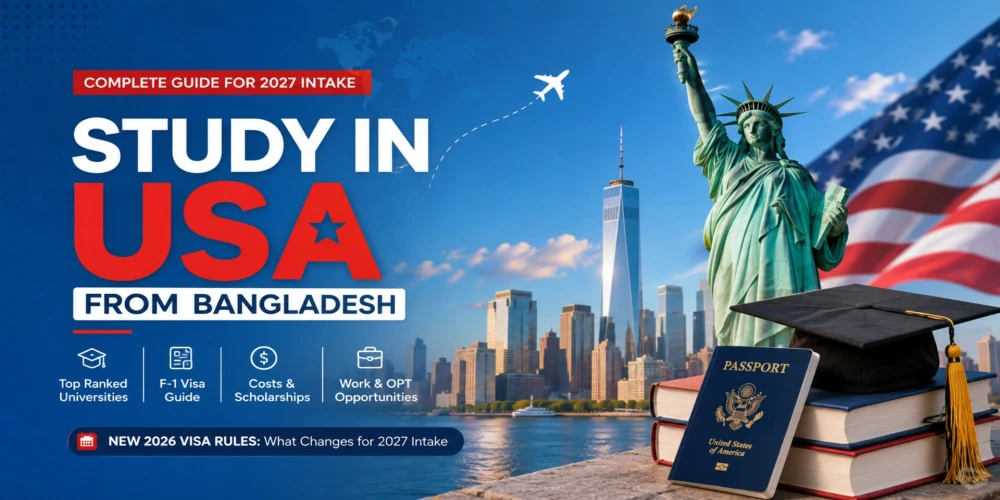
Study in USA from Bangladesh: Complete Guide for 2027 Intake
Studying in the USA from Bangladesh means applying to a university, securing an F-1 student visa, and budgeting roughly $25,000-$65,000 a year depending on the university and program. For the 2027 intake, there's one change every applicant needs to know before anything else: the U.S. government has ended "Duration of Status" for F-1 students, replacing it with a fixed admission period and a shorter 30-day grace period after graduation, effective 15 September 2026. This guide covers eligibility, GPA requirements, verified costs in USD and BDT, the updated visa process, and what the rule change means for your timeline.
Quick answer: To study in the USA from Bangladesh, you need a completed application with transcripts, IELTS/TOEFL scores, an SOP and LORs, an admission offer with Form I-20, an F-1 visa (SEVIS fee $350 + DS-160 fee $185), and proof of funds covering your first year. Budget $25,000–$65,000/year depending on program and university, and start your visa file at least 3- 4 months before your intake date.
2026 Visa Rule Change: What Changes for the 2027 Intake
On 17 July 2026, the U.S. Department of Homeland Security published a final rule ending "Duration of Status" (D/S) for F-1 students. The rule takes effect on 15 September 2026 - a date that falls right in the middle of most 2027-intake application cycles, so this affects nearly every Bangladeshi student applying now.
Here's what actually changes:
Fixed admission period instead of open-ended stay:
Previously, F-1 students could remain in the U.S. for as long as their program required. Under the new rule, students admitted on or after 15 September 2026 receive a fixed "Admit Until Date" tied to their I-20 program end date, capped at a maximum of four years.
Grace period cut from 60 days to 30 days:
After finishing your program, you'll have 30 days (not 60) to depart, transfer schools, change your academic level, or change status.
Extensions now require a formal USCIS filing:
If your program will take longer than four years, you'll need to file an Extension of Stay (Form I-539) with USCIS well in advance. DHS itself has flagged that this will add hundreds of thousands of extension filings a year, so processing times may stretch.
Transition provisions for students already in the U.S:
If you're admitted for D/S before 15 September 2026, you generally keep your existing 60-day grace period and open-ended status until you travel internationally and re-enter after that date, at which point you switch to the new fixed-date system.
What this means practically: if your 2027 intake starts after September 2026, you'll be admitted under the new fixed-date system from day one. Talk to your Designated School Official (DSO) as soon as you enroll about your program's expected completion date relative to the four-year cap, and plan any post-graduation OPT filing with the shorter 30-day window in mind. (Source: DHS/SEVP official rule summary, studyinthestates.dhs.gov)
Why Bangladeshi Students Choose the USA
The United States hosts more than 4,000 accredited universities and colleges, offering more program variety than almost any other study destination, from mainstream engineering and business degrees to niche interdisciplinary programs few other countries offer. For Bangladeshi students specifically, the pull is usually a combination of three things: globally recognized degrees that carry weight with both multinational and Bangladeshi employers, strong post-study work pathways through Optional Practical Training (OPT), and an established Bangladeshi student community across major university towns that eases the transition. Popular fields for Study in the USA among Bangladeshi applicants include computer science, data science, electrical and mechanical engineering, business administration, and public health, with STEM fields carrying an added advantage: STEM OPT extensions allow up to three years of total post-study work authorization instead of one.
Eligibility & Academic Requirements
Requirements vary by university and program level, but most Bangladeshi applicants should prepare for the following baseline:
For Undergraduate programs:
Completed HSC (or equivalent), with most competitive programs looking for a strong academic record; SAT/ACT is optional at a growing number of U.S. universities but still required or recommended by many.
For graduate programs:
A four-year bachelor's degree from a recognized institution; GRE or GMAT required by some programs, waived by many others (check each program individually; this varies widely).
English proficiency:
IELTS 6.5-7.0 or TOEFL iBT 80+ for most programs; competitive and graduate programs often expect higher.
Supporting documents:
Statement of Purpose (SOP), 2-3 Letters of Recommendation (LOR), academic transcripts, and a CV/resume for graduate applications.
Converting Your Bangladeshi GPA (Approximate Guide)
U.S. universities work on a 4.0 GPA scale, and Bangladeshi students often ask how their SSC/HSC or O/A-Level results translate. There is no single official conversion; each university's credential evaluator (or a service like WES) makes the final call, but the table below reflects the general conversion pattern most U.S. admissions offices and credential evaluators apply for the Bangladeshi National Curriculum scale.
| Bangladesh GPA (out of 5.0) | Approximate US GPA (out of 4.0) | General competitiveness |
| 5.00 (A+) | 4.0 | Highly competitive |
| 4.50 - 4.99 | 3.6 - 3.9 | Strong |
| 4.00 - 4.49 | 3.2 - 3.6 | Competitive for most programs |
| 3.50 - 3.99 | 2.8 - 3.2 | Meets baseline for many programs |
| Below 3.50 | Below 2.8 | Foundation/pathway programs recommended |
Indicative only. O-Level/A-Level (Cambridge/Edexcel) grades don't map to a numeric GPA at all; U.S. admissions offices typically evaluate these on a case-by-case basis using grade bands (A*-E) rather than converting to 4.0. Always confirm with your target university's admissions office or an official credential evaluator.
Key Terms You'll See Throughout This Process
F-1 Visa - The standard nonimmigrant visa for full-time academic study in the U.S. Distinct from J-1 (exchange visitor) and M-1 (vocational study) visas, which almost no Bangladeshi degree-seeking student needs.
I-20 - Certificate of Eligibility issued by your university once you're admitted and you've shown proof of funds. Your I-20 lists your program, expected start and end dates, and, under the new rule, determines your fixed "Admit Until Date." You'll need it for your visa interview, at U.S. port of entry, and any time you request travel signatures from your DSO.
SEVIS - The Student and Exchange Visitor Information System, the government database that tracks every F-1 and J-1 student from admission through graduation. Your SEVIS ID (starts with "N") stays with you for your entire U.S. study history.
DS-160 - The online nonimmigrant visa application form every F-1 applicant completes before their interview. It generates a confirmation barcode you must bring to your interview; a mismatched or incomplete DS-160 is one of the most common causes of delay.
Admit Until Date (AUD) - New term introduced by the September 2026 rule change. Instead of "D/S" (Duration of Status) on your I-94 record, students admitted on or after 15 September 2026 get a specific fixed date, tied to your I-20 program end date and capped at four years.
DSO (Designated School Official) - The staff member at your university authorized to manage your SEVIS record, sign your I-20 for travel, and advise you on status questions, work authorization, and, now especially, your Admit Until Date and any Extension of Stay filing.
CPT (Curricular Practical Training) - Off-campus work authorization tied directly to your curriculum (e.g., a required internship), available after your first academic year and authorized by your DSO, not USCIS.
OPT (Optional Practical Training) - Work authorization after graduation in your field of study, requested via Form I-765 with USCIS. Standard OPT is 12 months; STEM graduates can add a 24-month extension, for up to 3 years total.
EAD (Employment Authorization Document) - The physical work permit card USCIS issues once your OPT application is approved. You cannot legally start OPT work until you have this in hand.
Extension of Stay (EOS) - A new formal filing (Form I-539) required under the 2026 rule if your program will run longer than your fixed four-year admission period. File this well ahead of your Admit Until Date; DHS has warned that processing volumes, and therefore wait times, are expected to rise sharply.
SOP / LOR - Statement of Purpose and Letter of Recommendation, core application documents alongside transcripts and test scores.
Cost of Studying in the USA from Bangladesh (2027 Intake)
Costs vary significantly by university type, location, and program. The ranges below are compiled from multiple current sources and converted at approximately 1 USD = 123 BDT (August 2026 mid-market rate).
Figures are indicative, compiled from public sources current as of August 2026, and will vary by university and city. Sunrise's finance team should verify these ranges against current university-published fee schedules before this article is published.
For your F-1 visa application, you'll need to show proof of funds covering at least your first year of tuition and living costs, through bank statements, an education loan sanction letter, or a sponsor's financial affidavit. If you have dependents joining you, additional funds must be shown for each dependent's living costs.
Scholarships & Funding Options
Full funding is competitive but real: U.S. universities offer merit-based scholarships, teaching and research assistantships (mainly at the graduate level), and departmental funding. Government-backed options like the Fulbright Program cover tuition, airfare, living expenses, and insurance for successful applicants, though competition is intense and preparation should start 12+ months ahead. We cover funding routes for every major destination, including country-specific deadlines and eligibility, in our Scholarship Arrangement service.
Step-by-Step: The F-1 Student Visa Process
Get admitted and receive your I-20:
Once a U.S. university accepts you and you've submitted proof of funds, they issue Form I-20, the document everything else in this process depends on. Double-check the spelling of your name, your SEVIS ID, and your program dates the moment you receive it; errors here cause problems later at every stage.
Pay the SEVIS I-901 fee ($350)
Pay this online at fmjfee.com using your SEVIS ID from the I-20. Keep the payment confirmation receipt; you'll need to bring a printed copy to both your visa interview and, later, U.S. immigration at the airport. Payment must clear before you can book your interview.
Complete the DS-160 form online
This is the formal visa application, submitted through the U.S. Department of State's website. You'll upload a passport-style photo meeting strict specifications (plain white background, no glasses, specific dimensions) and answer detailed questions about your background, travel history, and program. Save your application ID and print the confirmation page with the barcode; this is mandatory for your interview.
Pay the visa application fee ($185) and schedule your interview
In Bangladesh, this is done through the official U.S. visa appointment portal (ustraveldocs.com). Appointment wait times at the U.S. Embassy in Dhaka fluctuate seasonally and can run from a few weeks to a few months during peak intake periods (May-August for Fall intakes), so book as early as your I-20 allows.
Prepare your full document set
At minimum: valid passport (with at least 6 months' validity beyond your intended stay), I-20, DS-160 confirmation page, SEVIS fee receipt, visa fee payment receipt, passport-size photo, academic transcripts and certificates, standardized test scores, and financial evidence (bank statements, loan sanction letter, or sponsor affidavit). Bring originals, not just photocopies.
Attend your visa interview
Consular officers typically decide within a few minutes, so preparation matters more than length of answer. Be ready to clearly and concisely explain your specific program choice (not just "the USA" generically), how you'll fund your studies, and your plans after graduation, including ties to Bangladesh that support your intent to complete your program as planned. Common reasons for refusal (221(g) or outright denial) include vague answers about program choice, weak or unclear financial documentation, and inconsistent answers between the DS-160 and the interview.
Understand your new Admit Until Date
If you're entering on or after 15 September 2026, immigration at your U.S. port of entry will record a fixed admission date on your I-94 instead of "D/S." Check your I-94 record online at the CBP website shortly after arrival to confirm this date, and calendar it against your expected graduation date.
Activate your SEVIS record and check in with your DSO
Within the first weeks of your program, your school will "activate" your SEVIS record; attend any mandatory international student orientation, as this is often tied to activation and to your DSO briefing you on work authorization rules under the new fixed-date system.
Plan around the 30-day grace period
After you complete your program, you have only 30 days to depart, transfer, or change status, down from the previous 60. Begin OPT paperwork (Form I-765) or any further-study plans several months before graduation, not after, since USCIS processing itself can take weeks to months on top of your grace period.
Work Rules: On-Campus, CPT, and OPT
F-1 students can work on-campus up to 20 hours/week during the semester and full-time during official breaks. Off-campus work requires either CPT (tied to your curriculum, available after your first academic year) or OPT (post-completion work authorization in your field). Standard OPT runs 12 months; STEM graduates can extend this by another 24 months, for up to three years of total work authorization, a major reason STEM programs are especially popular among Bangladeshi applicants. Always confirm your specific eligibility with your university's Designated School Official (DSO) before starting any work; on- or off-campus, unauthorized work can jeopardize your status.
Frequently Asked Questions
What GPA do I need to study in the USA from Bangladesh?
Most competitive programs look for the equivalent of a 3.0+ on the U.S. 4.0 scale, roughly corresponding to a 4.0+ GPA on Bangladesh's SSC/HSC 5.0 scale, though this varies by university and there's no single official conversion. Programs with lower thresholds and foundation-year options exist for students below this range.
How much does it cost to study in the USA from Bangladesh?
Total annual cost typically ranges from $25,000 to $65,000+, combining tuition ($15,000-$70,000+ depending on public/private and program) and living expenses ($10,000-$25,000). Public universities and smaller cities are generally more affordable than private universities in major metro areas.
How long can I work after graduating on OPT?
Standard Optional Practical Training (OPT) provides 12 months of work authorization in your field. STEM graduates can apply for a 24-month extension, for up to 3 years total.
What is the new 2026 visa rule change, and does it affect me?
Effective 15 September 2026, the U.S. ended open-ended "Duration of Status" for F-1 students, replacing it with a fixed admission period (capped at 4 years) and a shorter 30-day post-graduation grace period. If you're admitted for the 2027 intake, you'll fall under this new system from day one, so plan your program timeline and OPT filing accordingly.
Do I need IELTS or TOEFL to study in the USA?
Most universities require IELTS 6.5–7.0 or TOEFL iBT 80+ for admission, though requirements vary by program and some universities offer conditional admission with English pathway programs for students below these scores.
Written & reviewed by
Anisuzzaman Kiron, CEO, Sunrise Education Consultants. Anisuzzaman Kiron has 12+ years of experience guiding Bangladeshi students through USA university admissions and F-1 visa applications.
Founded in 2014, Sunrise Education Consultants has guided 2,500+ students abroad with an 80% visa success rate, from offices in Banani, Dhaka, and Sylhet.
Ready to Start Your USA Application? Book a free consultation with a Sunrise counsellor and get a personalized roadmap for the 2027 intake.
Sources: U.S. Department of Homeland Security final rule on Duration of Status (dhs.gov, 16 July 2026); SEVP/Study in the States official rule summary (studyinthestates.dhs.gov); currency data via Xe.com and Trading Economics (August 2026). Cost figures compiled from multiple publicly available 2026 sources and should be verified against current university fee schedules before publication.